Shirin Neshat
Artist Gallery


Artist Analysis
Shirin Neshat was born in 1957 in a small city located 2 hours away from the capital: Tehran. At the age of 17, she moved to the United States to finish her schooling however she could not come back to her home country for almost 20 years due to the Islamic revolution which started in 1979. Her works cover different themes such as: politics in Muslim nations, issues of gender equity, identity, as well as the link between the personal and the political. When Shirin returned to Iran all those years later, she had realised how much had changed – men would be able to control women, women who dressed however they desired to didn’t exist anymore, headscarves were mandatory to wear for any girl above the age of 9. During this time, Neshat projected her feelings into a series, ‘Women of Allah’ which included staged photos of women being arrested, holding guns, and also some in chadors.
When looking at the series, I felt a sense of sorrow. I wondered how demoralised the women who were forced into covering every inch of their body apart from their face would feel. As a proud Muslim, Iranian women I realised how privileged I am to be able to have freedom as to how I dress and practice my religion. The images are black and white however the lines of the writing on the face is red and it’s also curved as circles along her face. The chador in the image looks as if it has a velvety texture and the tone is mostly dark. The background is white which creates high-key lighting and contrasts the black chador. The image is a close-up shot and seems as if it has been cropped so that the face is arranged in the middle.
It is clear there is a soft, artificial light in front of the face because there are no shadows visible. The ISO is a little bit high as the image comes off as slightly grainy. I believe a large majority of the artist’s work are connected as she covers topics through her art: feminism, religion, violence, politics and more. I believe the main idea that she tries to communicate is equality for women especially those who have lost their freedom. As I have explored Shirin’s work, I have found myself to be fascinated and inspired to develop my own images imitating this series and I am particularly excited for this artist as I have experienced a similar journey to Shirin’s, through her experience with leaving Iran and returning to see the result of the Islamic Revolution.

Photoshoot Plan
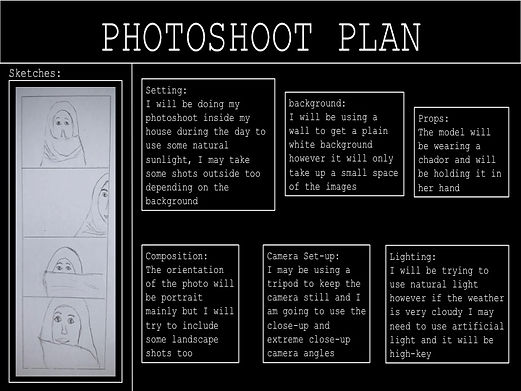
For my photoshoot, I intend to dress a model in a chador and take close-up photos of her in the style of Shirin herself. I am going to create my photoshoot at my house in front of a wall, this plan is going to help me direct my friends (who are modelling) and show them how I want them to pose. This photoshoot will replicate one of the images from the artists 'Women of Allah' series.
Contact Sheet

I believe my photoshoot turned out to be successful as I captured some shots that were similar to the piece. My photoshoot plan helped me think about the composition of the images although I could not include some of the props I originally planned to use. The marks on the images show which of the shots from the shoot I find successful and which I am not proud of. I think the images circled are more accurate to the artists work however if I were to improve this photoshoot, I would have added props such as handcuffs or a fake gun to make them more exciting. I intend to edit these images to make them black and white and layer Arabic writing onto the faces to recreate the original.
First Developments


I have created these edits on photoshop by using the 'hue/saturation' tool and turn down the saturation all the way to make the image black and white, then turning up the contrast on the 'levels' tool. Then I used the 'exposure' tool to increase the exposure. Then separately on a piece of paper, I wrote down two of my favourite Persian poems: one in red and in a circular motion, and another one in black in regular lines. Additionally, I took a photograph of the poems and double-exposed the writing on the faces and some on the backgrounds. I edited in this style to try to achieve a similar form to the artist. In order to improve I think that I should have maybe written a larger variety of poems so that there would be different types of writing to make the images more exciting.
Highlighting Success


I believe that these images are the most successful as they mimic Shirin Neshat's work the most. In the first image I double-exposed both of the poems that I had written onto one image which I quite liked. For the other two, I mostly chose these as my favourite because I appreciated how they were similar to the original image that I analysed.
Contact Sheet II


My photoshoot turned out to be successful in my opinion as I achieved some shots that I was proud of. I created this by wrapping black tape around the models hands and using black sheets of A3 paper to create a black background. The circled marks show the images which I am the most happy with, and the images with a cross show the shots which will not be used in my edits because they are not in focus or I am not pleased with the angles I took them in. I believe I could have improved the photoshoot by maybe adding some personal props that the model could have held to add more meaning to the photographs. I plan to edit these images in a similar way that Shirin Neshat did in her piece called 'Hands'.
Second Developments


I have created these edits on Photoshop by lowering the saturation and increasing the exposure to darken the background and also cropped or rotated any of the images. I then added a layer of writing in Persian that I had written myself(except for the second image) and double exposed the image by changing the layer to darker colour and using the eraser tool to rub out the writing where I did not want it. These images are different to my initial edits as I took the photographs of hands whereas the first edits were of a face - more inspired by the original piece of work by Shirin Neshat.
Highlighting Success


I believe these edits are the most successful because they have more detail; especially in the first edit, I believe it accurately depicted the oppression that women are go through, as you can see the black tape wrapped tightly around the skin. This is similar to how in Iran young girls are enforced to cover their skin.
Contact Sheet III

My photoshoot turned out successful as I achieved the outcome that I wanted and I feel as if the way the model's hands are placed in these photographs make them appear more mysterious. For this shoot, we used red string and tied it around the models hands and took some close-up shots. The string tied around the hands represents the oppression that women go through in Iran to have to cover up their body and hair.
Third Developments


My third developments I made by turning down the exposure with the 'levels' tool and I lowered the saturation however keeping the red colour of the string. I tried to focus on the composition of the knots of the strings and crop the image to zoom in on them.
Highlighting success


I have chosen these images to be the most successful because I like the placement of the hands as well as the red string being a pop of colour as it adds more differentiation to the edits.
Process Log

I zoomed in to the image and clicked on the saturation layer, then I used the brush tool and carefully went over the string
Next, I added a layer of Persian writing that I had written onto the image and changed the blending option
